Evidence & guides · Freely available framework
GenAI Assure v2.1: governance and security assurance for AI deployers
GenAI Assure is a cross-industry framework for organisations that procure, configure and operate third-party AI systems. It helps accountable leaders and practitioners identify AI use, assess risk, select applicable controls and reach conclusions supported by evidence.
Authored by Faisal Ali, AAISM, CISM, CRISC, and owned by ELSA AI LTD, Version 2.1 was published on 30 September 2026.
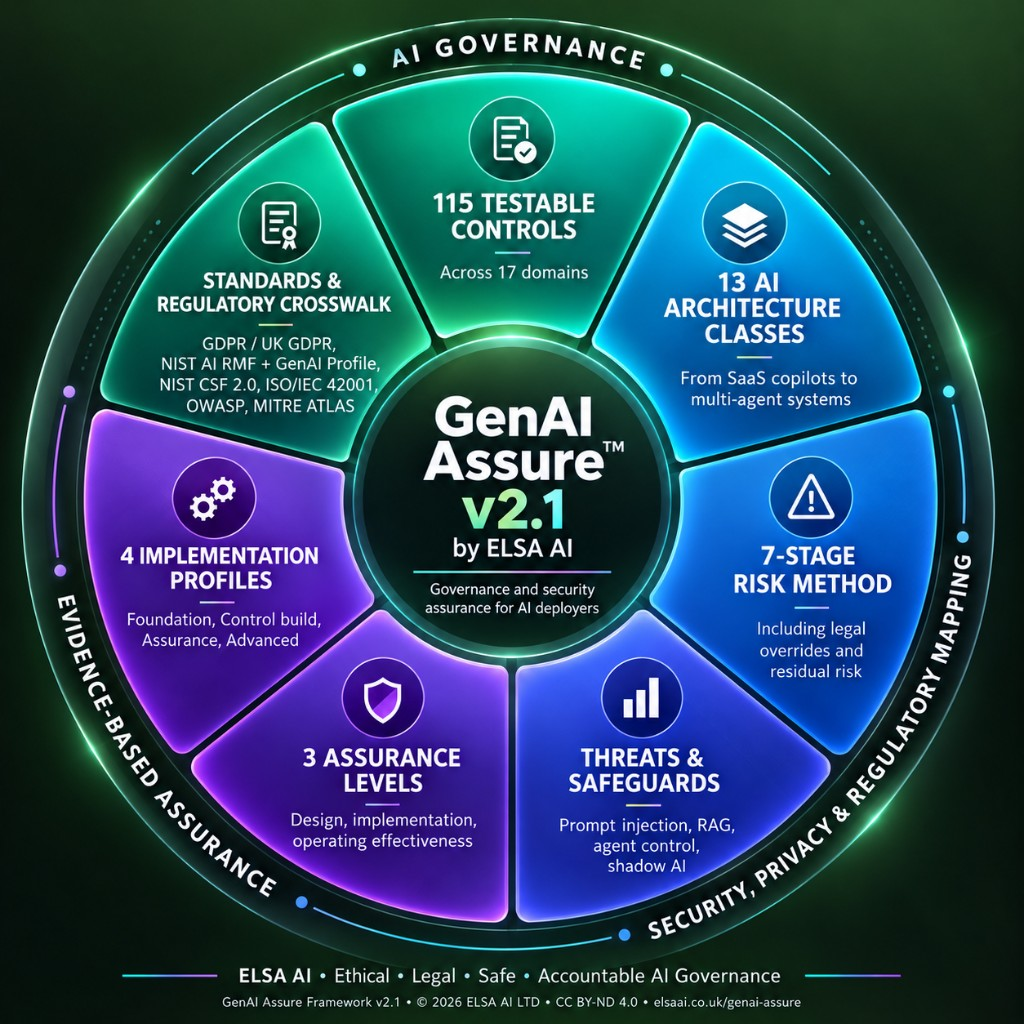
What the framework covers
Controls proportionate to each use case
The catalogue contains 115 individually testable controls across 17 domains. Each control defines its objective, accountable owner, applicability, evidence requirements and test reference.
Organisations select controls according to architecture, risk tier and actor role, recording the rationale for permitted exclusions.
A broad range of AI architectures
The framework covers 13 architecture classes: SaaS assistants and copilots; hosted model APIs; retrieval-augmented generation; fine-tuned or adapted third-party models; multimodal systems; workflow orchestration; single agents; multi-agent systems; browser and computer-use agents; plugin and MCP-style integrations; embedded AI; predictive machine learning; and meeting and communication AI.
Ground-up model development and training infrastructure are outside its scope. Where an organisation's activities may create provider obligations, the framework requires specialist escalation.
Structured risk assessment
A seven-stage method addresses prohibited uses, organisational actor status, system classification, mandatory legal overrides, inherent risk, control strength and residual-risk acceptance.
Four risk tiers guide proportionate safeguards. Budget and delivery deadlines do not reduce assessed risk or override mandatory requirements.
AI security, data protection and human oversight
The framework addresses prompt injection, sensitive information disclosure, unsafe output handling, overreliance and resource consumption.
It includes RAG source governance and retrieval permissions; agent identities, tool authorisation, containment and interruption; supplier assurance; data minimisation and retention; human review; guardrails and moderation; incident response; and resilience.
Evidence-based assurance and testing
Three assurance levels distinguish control design, implementation and operating effectiveness. A policy or configuration record alone does not demonstrate that a control works consistently.
Testing, evaluation, verification and validation requirements support use-case-specific test plans, acceptance criteria, adversarial testing, human-oversight checks and reassessment after material change.
Operational implementation
Operational playbooks support shadow AI discovery, incident handling, evidence management and lifecycle governance.
Implementation progresses through Foundation, Control build, Assurance and Advanced profiles. Progress depends on meeting exit criteria and producing sufficient evidence. There is no universal 30–60–90-day completion promise.
Standards and regulatory mapping
The framework includes a crosswalk to instruments such as the EU AI Act, GDPR and UK GDPR, NIST AI RMF and its Generative AI Profile, NIST CSF 2.0, ISO/IEC 42001, OWASP guidance and MITRE ATLAS.
The crosswalk explains where the framework supports alignment and where coverage is limited. It does not establish certification, regulatory endorsement, production readiness or legal compliance.
Download the framework
Download GenAI Assure Framework v2.1 (PDF)Publication edition · 30 September 2026
© 2026 ELSA AI LTD · CC BY-ND 4.0
Using and sharing the framework
The framework is licensed under the Creative Commons Attribution-NoDerivatives 4.0 International licence.
You may copy and share the licensed content, including commercially, with appropriate attribution and the required notices. You may produce adaptations privately, but may not share adapted material under this licence. Necessary format changes are permitted. The licence's full terms and applicable statutory exceptions govern.
Suggested attribution:
"GenAI Assure Framework v2.1 (2026), by Faisal Ali, AAISM, CISM, CRISC. © 2026 ELSA AI LTD. Licensed under CC BY-ND 4.0."
Retain supplied copyright, licence and disclaimer notices, and link to the source where reasonably practicable.
The ELSA AI name, logo and related branding are trademarks of ELSA AI LTD and are excluded from the copyright licence. Use suggesting endorsement, partnership or sponsorship requires prior written permission. Branding may remain in a faithful copy of the framework; this does not authorise separate promotional use of the logo.
For private healthcare providers
ELSA AI applies relevant framework requirements through clinical governance engagements scoped to the provider's AI use, patient-data exposure and available evidence.
The Clinical AI Exposure Diagnostic™ is a practical starting point for documenting that position and identifying priorities. Further technical testing, implementation support or operating-effectiveness assessment depends on the agreed engagement scope.
For the wider AI governance community
The framework is available to organisations and practitioners across sectors. Follow Faisal Ali on LinkedIn for wider discussion of AI governance, security and assurance.
Connect with Faisal Ali on LinkedIn